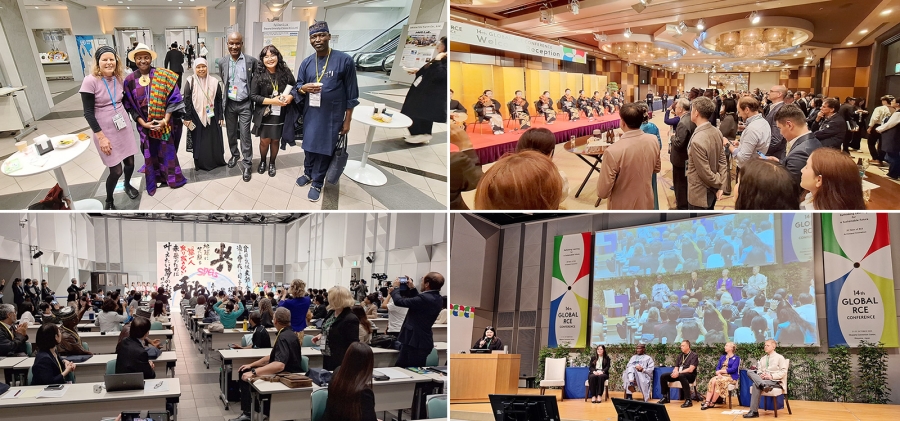
The 14th Global Conference of Regional Centres of Expertise for Education for Sustainable Development, which took place from 21 to 23 October 2025 in Okayama, Japan, was attended by over 260 participants from around the world. The event provided a recap of the global RCE network’s 20-year history. The COPERNICUS Alliance was represented in the Ubuntu Committee of Peers for RCEs by Advisory Board member Jana Dlouhá.
Written by: Jana Dlouhá
The primary objective of Regional Centres of Expertise for Education for Sustainable Development (RCEs) is to promote the transformative potential of education for sustainability within the context of a given region, fostering the democratic participation of local stakeholders, particularly universities. Currently, there are 200 RCEs worldwide, and their regional hubs (i.e. their European, African, American and Asian networks) discuss and develop common strategies. The European hub is coordinated by RCE Scotland, which is based at the University of Edinburgh. This network organises regular consultations with its members and offers opportunities to develop cooperation projects.
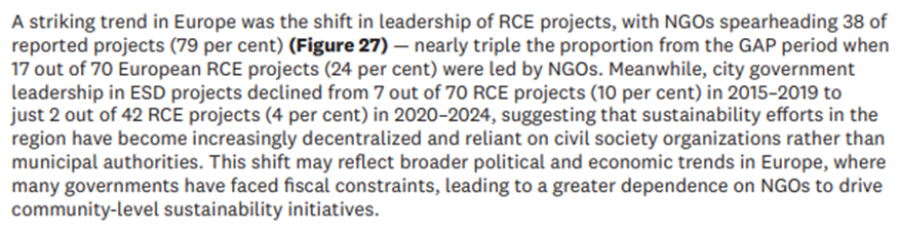
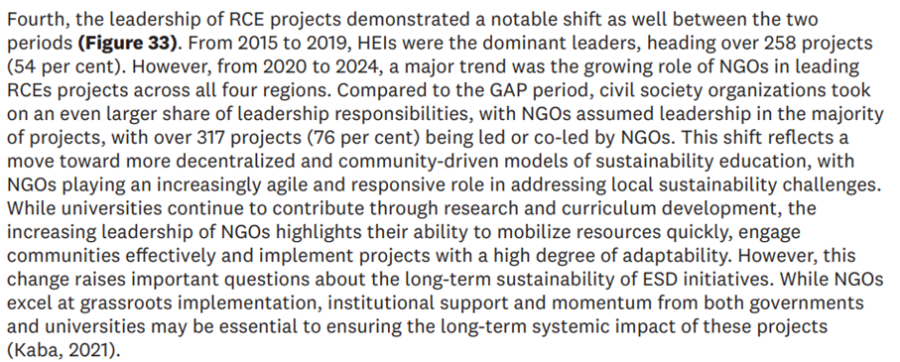
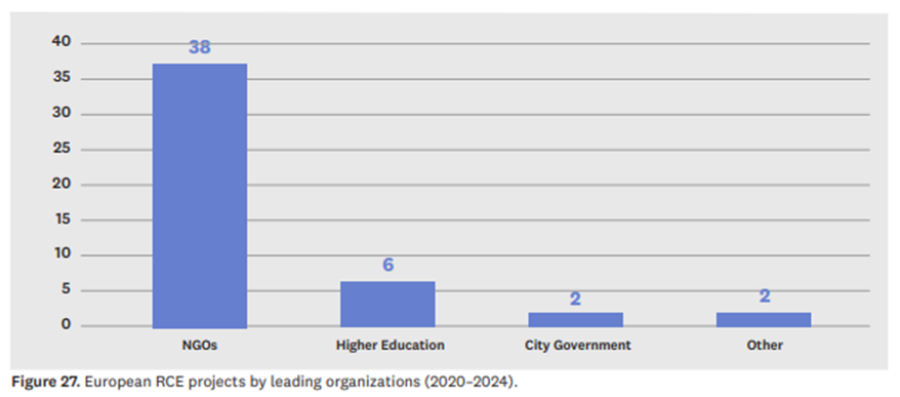
The history of the RCE network and examples of activities are summarised in the publication: Learning, Collaborating and Transforming: The 20th Anniversary of the Global RCE Network. This publication describes how individual RCEs operate under specific conditions and in different cultural contexts, as well as how they approach achieving their goals. It also enables us to compare the work of RCEs across regions. These comparisons reveal that regions have different priorities regarding their preferred SDGs, with the number of projects being proportional to the size of the regional network. A notable finding is that, compared to the 2015–2019 period, the leadership of individual RCEs has shifted – previously, universities were more often in the lead, but now it is more likely to be non-governmental organisations (see image). This suggests a potential future crisis regarding the continuity of funding for their projects. It also indicates that the transformation of universities towards a focus on their third role has been unsuccessful and is gradually fading away. However, this evolution could present an opportunity for the COPERNICUS Alliance and other networks of higher education institution networks to engage more with communities.
|
|
 |
 |
 |
Source: UNU IAS (2025). Learning, Collaborating and Transforming: The 20-Year Journey of the Global RCE Network. Online https://unu.edu/publication/learning-collaborating-and-transforming-20-year-journey-global-rce-network
The global RCE network was established to contribute to the implementation of the UNESCO Decade of Education for Sustainable Development (2005–2014). The RCE concept was based on education, with mutual learning processes intended to link the participating organisations and help them achieve common goals. Following the end of the Decade, the network continued its activities, focusing on the Sustainable Development Goals (SDGs) and their implementation in education. To make these broadly formulated goals easier to translate into the context of RCE work, a separate Roadmap for the RCE Community (2021–2030) was created based on them. Progress towards these goals is halfway through this year, so it has also been possible to take stock of progress so far. Among the interesting resources created for the 20th anniversary are guidelines for the application of action-oriented pedagogy, including practical examples.
Conference participants shared best practices and experiences from around the world gained over two decades of sustainability education practice with various target groups. The discussions emphasised the important role played by young people today: they are co-creators of sustainable solutions, participants in intergenerational learning and initiators of practical change. Other topics discussed in the context of international cooperation ranged from politics and pedagogy to community involvement and the role of new technologies. This emphasised the diversity of approaches within the global RCE community. At the conclusion of the RCE World Conference in Okayama, the RCE network adopted the "The 2025 Okayama Declaration: RCEs’ Collective Commitment for Sustainable Futures", summarising the state of global efforts to promote education for sustainable development in a regional context and indicating the way forward. The activities of the RCE network are coordinated by the United Nations University’s Institute for Advanced Studies in Tokyo and funded by the Japanese government – both of which deserve the highest appreciation! However, this financial support has been substantially reduced from this year onwards.